Romans 12:1 tells us not to be conformed to the ways of the world. The strength of the Church is in her uniqueness. Our victory is in the peculiarity of our faith and not in our conformity to worldly standards.
We might adopt their technology. We might use their gadgets. But we must be careful not to conform to their culture. Our words must not be like theirs – ours must be seasoned with the Grace of God that dwells in us.
Our lifestyles must be unique from theirs. We must be consecrated unto God. Until the Church restores her culture of uniqueness, she will remain powerless.
Nathaniel Stephen is a healing Evangelist based in the Nigeria. He is full of the power of The Holy Spirit, and is being used mightily by God to bring revival upon Nigeria and the globe.
In this interview with Koinonia Art’s Journalist, Godwin Wobo, Stephen that shares with us, his life story.
(Interviewer’s Questions in Bold Italics)
Tell us about your Background.
I am from a good family background. My Mom was an Evangelist, not necessarily by title, but she did the work of an EVANGELIST alot.
She would be sick, yet, would still go for Evangelism. Her bad health could not stop her. She was definitely a woman full of pious love and reverence for the things of God.
My Dad was not really stable, but God was helping him.
I got born again in 2014. It was a beautiful experience. But a while later, I backslid. I fell from The Faith.
I totally changed in 2016. No one preached to me. I had an Encounter with God that transformed me overnight, and made me come back to the Lord.
How was the inception stage of your ministry?
It was pretty cool. I think I would have preferred it to what I see now. I hated crowds. I love to be hidden. Then, it was just myself and twelve others that the Lord had sent to me. Eventually, things began to change. Doors of expansion began to open, and here I today, more known than I was before.
What was your greatest challenge in ministry?
I have faced several challenges in ministry. Both Physical and Spiritual challenges. But I think the greatest of these challenges is that, I was very determined to know who my wife would be, (laughs).
I was so interested in knowing God’s will for my marital status, that I began to get distracted from God’s purpose for my ministry.
Thank God for His enlightenment. I realized it was a mere distraction. When the right time comes, the right woman would come.
But it was a challenge overcoming those thoughts and obsession with who I might marry.
You have witnessed several incredible miracles of God in your life. Yet, which of these miracles would you describe as very fascinating?
For me, there is no Miracle which is greater than the miracle of salvation.
As you said, God has performed incredible miracles in my ministry. I have seen miracle alerts, HIV Positive turn Negative, deaf ears opened, Blind eyes seeing, Ulcer dissipating etc. The list is endless. God has been very faithful to us.
In spite of these, I’ll still say that the Miracle of salvation is the greatest.
There is no Miracle as great as a sinner becoming a saint; a strumpet becoming a prophet; an atheism extremist becoming a lover of the Gospel.
These are miracles we see daily. Lives transformed. Minds renewed. There is no Miracle as great as that.
Ever since its inception, your ministry has thrived. Despite the Pandemic and lockdown, it keeps growing bigger. Evangelist, what is the secret to the continuous thrive of your ministry?
Quite a lot of persons have asked me that question. And when they ask me, they probably expect a big answer.
But the secret to my success in Ministry is that I always follow the leading of The Holy Spirit. What He says I should do, I do. What He says I shouldn’t do, I do not do. The Holy Spirit is very important to success both in ministry and in every other endeavor.
I do not even see this work as my ministry. It is His Ministry. I am merely the caretaker.
He has His compass orchestrated for the leading of His Ministry. As His caretaker here on Earth, my job is to continually look at that compass and align myself with the angle it is reading.
Sir, you’re a a student, as well as a preacher. These two facets of life can be quite tasking and demanding of attention. Yet, you’re excelling in the both of them. How do you do that?
God helps me in my academics. It may seem unbelievable, but when I’m preparing for exams, I do not read the entire topics in the recommended texts.
The Holy Spirit directs me to the topics from which the exam questions will be set. I study those topics intensively, and discover on the day of the exam, that indeed, the exam was set from them.
What are some of the things you are grateful for in Ministry?
I am presently in full time ministry and am grateful for many things.
The crowds that turn up at our crusades. The speed He granted me. His mercies He has shown me. The signs and wonders . The expansion in finances, numbers etc.
I am very grateful to God for these things and I attribute them to nothing else but His Grace.
What advice would you give to ministers globally. Especially the young ones?
While you have alot of prophecies over your life, ensure to yield to divine Instructions and principles. Young ministers are particularly stubborn when it comes to following God bureaucratically.
The passions of ones youth can tempt one to serve God recklessly. But God is a God of order. And He be followed based on the Principles which He has revealed in Scriptures, and the Instructions which He gives to us through The Holy Spirit.
Never attend a meeting God wants you to attend without leaving that meeting with a decision made and an action to take.
________________________
We hope you have been blessed by the written highlights of this phenomenal interview with Nathaniel Stephen.
Meditate wholly on these things. Imbibe the lessons into your heart, and practice them.
The Lord Bless You.
Do not forget to drop a like and leave a comment. We would love to hear from you.
Spiritual strength, as opposed to physical strength, is the extraordinary ability to engage yourself in spiritual things. It is also the ability which enables you to withstand spiritual difficulties.
Generally speaking, without spiritual strength, spiritual things cannot be handled. Hence, it becomes mandatory to “build spiritual strength”.
In this context, ‘building’ means ‘enhancing’ while ‘strength’ means ‘capacity’. By rephrase, it means enhancing our spiritual capacity.
Therefore, building spiritual capacity is the work of engaging in spiritual workouts to generate the required ability to function adequately. It is a deliberate effort to gain spiritual fitness or stamina.
For example, we build our mortal body and gain fitness by doing physical exercise. This can be similarly considered with spiritual exercise, we engage in spiritual things to strengthen our faith and enhance our capacity at different levels.
On the other hand, we eat foods which builds our body cells and supplies energy from the organelle called mitochondrion. Under some situations, protein can serve as a valuable energy source.
A class of proteins known as fibrous proteins provide various parts of your body with structure, ‘strength’ and elasticity. They provide nutrients which transport throughout your entire body, and stored for usage.
In addition, carbohydrates are body’s main source of energy. They provide energy, store energy, build macromolecules, and spare protein and fat for other uses.
In that comparative case, the word of God is the spiritual food that provide wholesome nutrients, those nutrients are the living particles of the Spirit. He transport the energy that enables us to be builded on daily basis.
“LET the word of Christ dwell in you RICHLY in all wisdom….” Colossians 3:16
You will be builded and enriched by the word of Christ ‘if’ you unreservedly and consistently behold it.
Paul said LET, which means PERMIT or ALLOW. Until then will Christ’s word be able to dwell RICHLY in you. This imply that the degree to which He’ll dwell in you, is proportional to the degree of your allowance.
If your degree of allowance is little, then His word is dwelling poorly in you. This shows you are responsible for your spiritual capacity, you are accountable in building it while the Holy Spirit is responsible for supplying help which facilitates you to build it.
The Holy Spirit provides spiritual strength but it is the duty of believers to initiate and intensify the strategy, which must be in place for spiritual capacity building.
Therefore, what is the strategy to building spiritual strength? This and more will be revealed in the next part of this series.
Wesley Kayode Luther is the founder and senior pastor of The Revival Train International Ministry.
His ministry, which once began from preaching to secondary school students, has rapidly grown to becoming a global revival ministry.
In this interview with Koinonia Art Founder, Nwodo Divine, Wesley Kayode Luther shares with us, important information about his life and his thrive in ministry.
Interviewer’s Questions in Bold Italics
(Interviewer’s Questions in Bold Italics)
Evangelist Wesley, thank you very much for agreeing to this interview. Could you give us a brief biography about yourself and your background, as well as how you got into the faith.
I was born into a Christian family. From childhood, I was taught about purity by my Sunday school teacher. I grew up living my life in purity and chastity.
But I was goodly, yet, not godly. To be goodly is to be morally upright. It is different from being Godly.
Being Godly is a step further from being goodly. Godliness is living the God-kind of life on Earth.
One day, I came across John 3:3. It really astounded me. I read it audibly. Fortunately, my mom was there with me. She explained it in details to me, in a manner which convinced me deep in my spirit.
My mom led me to Christ that day. That is how I came into the faith.
How did you discover that you were called into the ministry. Also, what was your response to the call.
Well, after I gave my life to Christ and got born again, I pursued the things of God with a lot of zeal and fervency.
My eyes were blind to the calling of God upon my life, until the Lord began to give me instructions to carry out.
I took counsel from different fathers in faith in regards to my divinely ordained purpose.
Amazingly, they all gave answers that were aligned. One thing that was common in all their counsels, was that I was called into ministry.
What was the initial stage of your call like?
I started by going from school to school, especially secondary schools, preaching the Gospel and introducing students to Christ.
My ministry was centred on secondary school students until the Lord extended my borders.
What has been your greatest battle in ministry
I have had a lot of battles in ministry, but I think the greatest of them all is consistency. I battled with being consistent in whatever project, Spiritual and otherwise that I engaged myself in. I believe I’m gaining grounds in that battle now.
What would you describe as the greatest miracle of God in your ministry?
God, in His infinite mercy has done a lot of great things in my Ministry. We’ve seen several drastic Miracles. Yet, none of this enrapture me as much as the miracle of salvation.
I love it when men receive salvation and get totally transformed. It is always a great experience. I consider the miracle of salvation to be the greatest miracle of God on Earth.
And I am grateful to God, that I am seeing that miracle happen frequently in my ministry.
What has kept your ministry thriving?
Love and affection to see people change and most importantly, spending more time daily to God and hearing God before action is taken.
I had many opportunities that came my way as a minister. Although, they seemed to be attractive and glittering, I rejected them because of the counsel of God to me.
The secret to success in ministry lies in ones ability to always hear from God before making decisions.
How do you balance between your ministry and other aspects of your life?
I live with vision and focus. Those two things are very important in having a balanced Christian Life.
What is your final advice to ministers?
Let every minister be patient with God. Patience is virtue. It is golden. The Voice of God must equally be prioritized in a minister’s life. You must not do things haphazardly.
Love must also be the lifestyle of the Minister. He must love with all his heart. The transformation of people must be his priority and his joy, and not mere material resources.
There is a preaching that does the expected; exciting young men and women; and a teaching that makes the elderly nod in deep thought, say the occasional Amen, and afterwards shake the hand of the preacher as a measure of appreciation. We bless God for that.
Yet, we also know that the teaching of a good orator that knows understands oratory and connecting to people’s emotions, may be able to do the same. One who knows how to steam a powerful message in a broth of rhetoric and cadence, spiced with an impassioned voice and well timed gesticulations; will surely steer the audience, but only the expected will occur.
Only those who like speeches will be impressed. Only those who are happy, will smile. Only those who are okay will clap. Only those who are young will, hoot, and make a great deal of noise, “yea!”, “aye!”, “on point siiiir!”, “preach!”
Yet…
The rich will not embrace the poor. The hypocrite will not relent. The sinner will not repent. The aged will not dance. The hurting will not be healed. The agnostic will not be persuaded . The stingy will not give, and The offended will not forgive.
However, there is that preaching that readily produces the unprecedented, and easily accomplishes the impossible.
THAT PREACHING that is the current ministry of the Holy Spirit. That is a ministry of weakness, brokenness, fear, and much trembling, and yet one of the demonstration of the Spirit and of power.
THAT PREACHING that is a ministry of love. A ministry of righteousness, peace, and joy in the Holy Ghost. That chooses the least likely, and exalts the most unexpected; that destroys artificial barriers, dissolves race, casts out caste
THAT PREACHING that is the message of the Cross. That confounds the wise and turns the knowledge of this world into foolishness
THAT PREACHING that knows no man after the flesh, but beckons to all, man or woman, black or white, great or small, Jew or Gentile, to come to the Cross – the place where everything previous, everything Adam may end, where Christ and Him crucified becomes the common denominator by which all old things are passed away.
THAT PREACHING which by the same vital force that raised up Christ from the dead, becomes the platform alone upon which we here the glorious shout that breaks the hold of darkness “Behold, All Things Are Become New!”
THAT GOSPEL that
Thoroughly forgives the sinner, And makes him completely new. Restores the brokenhearted, Broken dreams, broken minds, broken homes. That heals the sick, And restores the life of the dead. Dead lives, dead bodies, dead marriages, That turns sworn enemies into trusted friends. That sets the solitary in families, And gives the desolate an inheritance. That enriches the poor, And makes the barren more fruitful than the fertile.
THAT PREACHING that fixes teenagers to their seats for the quarter of a day, taking notes, resetting the tiny visions which they had previously thought mighty, and digging deeper stakes, all the while praying under their breath, and seeking the face of God; replacing ambition with vision, so that instead of preparing to take over the world, rather deciding to let the Lord take over their lives; [for it is only when Jesus is Lord of one’s life that one may gain the whole world and still possess and keep his soul]
THAT PREACHING that turns a roomful of elders in their 70s and 80s, loose in tongues, pacing, jumping, laughing, and running about prophesying and rejoicing, for hours on end…judging God faithful, speaking of things to come, against hope believing in hope, receiving strength to bring forth, and giving glory to His name.
That pregnant virgin, king in a manger, God in a diaper, Savior on a cross, criminal in paradise, graveyard dwelling madman-into-sound evangelist,
pharisee terrorist-into-apostle and bond servant of Christ-making, sinner-into-saint,
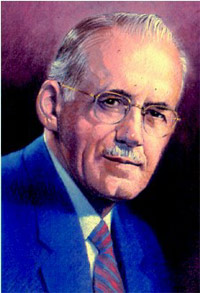
Born April 21, 1897, in the mountainous region of western Pennsylvania, Aiden Wilson Tozer influenced his generation like no other individual.
During his lifetime, Tozer, as he preferred, earned the reputation of a twentieth-century prophet. His spiritual gifts afforded him a degree of insight regarding biblical truth and the nature and state of the evangelical church in his day.
Able to express his perceptions in a beautiful, simple, forceful manner, Tozer was often the voice of God when the words of others were but echoes. He saw through the fog of modern Christianity, pointing out the rocks on which it might flounder if it continued its course.
Just before his 17th birthday, Tozer heard a street preacher on a corner in Akron, Ohio, as he walked home from his job at a rubber factory. He could not shake off the simple message. “If you don’t know how to be saved,” the preacher said, “just call on God, saying, ‘Lord, be merciful to me a sinner.'” Wrestling with God for some time at home, Tozer emerged from his attic sanctuary a new creature in Christ.
Under the tutelage of his future mother-in-law, Tozer progressed rapidly in the things of God. She encouraged him to read good books, study the Bible, and pray. She also urged him to preach, often gathering people in her home to hear him.
In 1919, without formal education, they called Tozer to pastor a small storefront church in Nutter Fort, West Virginia. In these humble beginnings Tozer and his new bride, Ada Cecilia Pfaust, launched a ministry that was to span some forty-four years in The Christian and Missionary Alliance. Other churches in Indiana and Ohio would follow.
In 1928 Tozer received a call from The Southside Alliance Church in Chicago. Not too anxious to leave his congregation in Indianapolis, he pushed aside the invitation. After some persuasion Tozer agreed to go and preach, but he offered no guarantees.
That first Sunday in Chicago was notable. Francis Chase, a commercial illustrator, and close friend of Tozer’s, remembered that first service. “He said very little and I didn’t expect much.
He was slight with plenty of black hair, and certainly not a fashion plate as we say. He wore a black tie about 1 1/4 inches in width. His shoes were even then outmoded; high tops with hooks part way up. I introduced him and left the platform.
He said nothing about being pleased to be there or any other pat phrases usually given on such occasions, but simply introduced his sermon topic, which was, “God’s Westminister Abbey,” based on the eleventh chapter of Hebrews.”
Writing to a friend after accepting the call to Chicago, Tozer confided, “As soon as I passed the city limits of Indianapolis I had a favorable earnest of my decision. There swept over my soul a sweet peace and I knew that I was in the will of God.”
From the first, his approach to preaching captivated the congregation – with superior language and phrases – and his splendid voice and diction. Numbering around eighty people when Tozer began, the congregation had to build larger facilities in 1941 to accommodate about 800.
Many felt there were only two great churches in Chicago: Moody Memorial Church with Harry Ironside and Southside Alliance Church where Tozer pastored. Hundreds of people, especially nearby college students, flocked to his services.
From 1951 to 1959 Tozer’s ministry enlarged when WMBI, the Moody radio station, broadcast a weekly program originating from his church study. His ministry to the nearby Bible colleges was his special delight. Tozer pastored the Southside Alliance Church from 1928 until 1959, when he accepted the call from the Avenue Road Alliance Church in Toronto, Canada.
Tozer was fond of saying, “I refuse to allow any man to put his glasses on me and force me to see everything in his light.” He literally burned the midnight oil in his quest for truth. Giving himself to the study of the great classics in religion, philosophy, literature, poetry, the church fathers and Christian mystics.
His special love for poetry and the hymns of the church gave wings to his preaching and writing. A voracious reader, he would read a bit, then think and meditated on what he had read. He often said, “You should think ten times more than you read.” He never read a book merely to say he had read it.
Always a book was to lead him on in his quest for God. In an editorial on the subject Tozer said that the best book was the one that starts the reader on a train of thought and then bows out, its work finished.
In 1950 Tozer was elected editor of the Alliance Weekly, now the Alliance Life, official magazine of The Christian and Missionary Alliance. The committee that presented Tozer’s name said of him, “His clear and forceful style and Bible-loving Christians will approve his unique presentation of a Christ-centered gospel . . . everywhere.”
That proved prophetic, as under Tozer’s leadership the magazine doubled in circulation. The Alliance Weekly, more than anything else, helped establish Tozer as a spokesman to the evangelical church at large.
Someone observed that the Alliance Weekly was the only magazine subscribed to solely for its editorials. Many subscribed to the Alliance Weekly simply for Tozer’s pungent editorials and insightful articles.
They simultaneously published his editorials in Great Britain. H.F. Stevenson, editor of The Life of Faith magazine in London, England, said, “His survey of the contemporary scene was as relevant to Britain as to his own country, so that his articles and books were read avidly here also.”
Tozer’s forte was his prayer life. He often said, “As a man prayed so is he.” To him the worship of God was paramount in his life and ministry. He believed that true service would flow out of pure worship. His preaching and his writings were but extensions of his prayer life. What he discovered in prayer soon found its way into his sermons, then articles and editorials and finally into his many books.
Tozer greatly appreciated craftsmanship and excellence. His writings reveal that he demanded the utmost from himself. Wide reading and a disciplined mind provided him tremendous resources for the apt expressions that flowed from his tongue and pen. Often he would say, “There’s a right word; use it.” Invariably he had the right word at his fingertips.
The great care with which he produced his books established him as a devotional writer of a classic nature who will long be read when we forget his spoken ministry. He labored diligently to develop a style and strength of expression that continually attracted attentions.
Tozer’s lively imagination and descriptive powers gave force and vividness to his presentations. He spent hours meticulously producing sermons that we could describe as majestic and profound. Instead of shouting, he used crisp, precise, climatic sentences. His voice and delivery were rather quiet, but the sermon penetrated the soul.
Through his preaching and writing Tozer issued a clarion call for evangelicals to return to authentic, biblical, personal and inward positions that characterized the Christian church when she was most faithful to Christ and His Word. As he expounded the Scriptures, analyzing, or explaining a biblical truth, listeners were brought face to face with decisions they would never forget or regret.
As an intellectual beast of prey, Tozer could tear the faulty arguments of an author to pieces. He seemed to have a spiritual intuition enabling him to scent error, name it for what it was and reject it in one decisive act.
Francis Chase, close friend for more than thirty years, shares this insight into his work habits. “He told me once that he would often go to that little dismal loft in the church to write some editorials. He said his heart and mind were as dry and uninspired as a burnt shingle.
He would open his Bible, possibly a hymnbook, kneel at that old couch, pick up a pencil, and then the Holy Spirit would come upon him . . .. To keep up with what flooded his soul he would have to write ferociously. Four or five editorials would be completed at one time.”
The freshness of his writings amazes some. A close friend and colleague, Dr. Nathan Bailey, late president of The Christian and Missionary Alliance, explains, “In his writings he left the superficial and the obvious and the trivial for others to toss around, giving himself to the discipline of study and prayer that resulted in articles and books that reached deep into the hearts of men.”
Tozer’s method of preaching was the strong declaration of biblical principles, never merely an involvement in word studies, clever outlines or statistics. Listening to his recorded sermons or reading any of his books, the observer will notice the absence of alliteration. He thought alliteration was artificial. His style was the simple unfolding of truth as naturally as a flower unfolding in the sunlight.
Much like that of Will Rogers, we can describe Tozer’s humor as good, honest, homespun wit. He was not a storyteller or joke-teller, but in the turn of a phrase, a sharp observation through satire or a homely illustration, he got his point across.
Of course too much humor can be ruinous to any sermon, and Tozer struggled to keep his humor under control. Raymond McAfee, long time associate of Tozer in Chicago, said, “I could always tell by the content of humor in his preaching just how tired he was. When his discourse convulsed the audience, he was tired, his guard was down, and humor sneaked through.”
In the true and best sense of the word, Tozer was a mystic. He placed great emphasis on the contemplation of divine things resulting in the God consciouslife.
The last literary project of Tozer’s, completed just before his death and published several months after, was THE CHRISTIAN BOOK OF MYSTICAL VERSE. This was a compilation of a wealth of mystic poetry that had warmed and blessed Tozer’s heart throughout the years. In their introductions of that book he defined his meaning of the term mystic.
“The word ‘mystic’ as it occurs in the title of this book refers to that personal spiritual experience common to the saints of Bible times and well known to multitudes of persons in the post biblical era. I refer to the evangelical mystic who has been brought by the gospel into intimate fellowship with the Godhead.
His theology is no less and no more than is taught in the Christian Scriptures. He walks the high road of truth where walked of old prophets and apostles, and where down the centuries walked martyrs, reformers, Puritans, evangelists and missionaries of the cross.
He differs from the ordinary orthodox Christian only because he experiences his faith down in the depths of his sentient being while the other does not. He exists in a world of spiritual reality. He is quietly, deeply, and sometimes almost ecstatically aware of the Presence God in his own nature and in the world around him.
His religious experience is something elemental, as old as time and the creation. It is immediate acquaintance with God by union with the Eternal Son. It is to know that which passes knowledge.” (THE CHRISTIAN BOOK OF MYSTICAL VERSE, Christian Publications, Harrisburg, Pennsylvania).
In his daily walk and ministry Tozer had a sense of God that enveloped him in reverence and adoration. His one daily exercise was the practice of the presence of God, pursuing Him with all his strength and energy. To him, Jesus Christ was a daily wonder, a recurring astonishment, a continual amazement of love and grace.
Toward the end of his life Tozer remarked, “I have found God to be cordial and generous and in every way easy to live with.” For almost fifty years Tozer lived in God. He was not a perfect man; He had his faults and “warts,” possessed a disposition that caused him grief and heartache. Although never nasty or venomous, at times he had to apologize to those he inadvertently hurt when he spontaneously popped their balloons of pretense, pomposity and posturing.
Toward the end of his ministry he requested of his congregation: “Pray for me in the light of the pressures of our times. Pray that I will not just come to a wearied end ?- an exhausted, tired old preacher, interested only in hunting a place to roost. Pray that I will be willing to let my Christian experience and Christian standards cost me something right down to the last gasp!”
On May 12, 1963, A.W. Tozer’s earthly labors ended. His faith in God’s majesty became sight as he entered His presence. At the funeral his daughter Becky said something typical of what Tozer himself would have said. “I can’t feel sad; I know Dad’s happy; he’s lived for this all his life.” And so he had. Although his physical presence is far removed from us, Tozer will continue to minister to those thirsty for the things of God.
Charles Spurgeon was a unique combination of personality and prayer. His multifaceted ministry life fell into orbit around his devotional life.
But how did Spurgeon remain devoted to God in the midst of all the distractions that constantly pulled at his attention?
How did Spurgeon keep his focus on Jesus Christ admist the crashing waves of life?
Here are several lessons from Spurgeon about maintaining intimacy with God in the busyiness and routine of everyday life.
1. Experience intimacy with God through the personality He has given you.
Spurgeon had a marvelous and magnetic personality. He was winsome, profound, easy to speak with, and he never forgot a face.
He once told his students, “I once counted eight sets of thoughts which were going on in my brain simultaneously, or at least within the space of the same second.”
No doubt, his memory assisted his pastorate that contained nearly 6,000 members. It was, indeed, a “megachurch” long before that word ever came into the vernacular.
Spurgeon provided oversight to sixty-six organizations, preached multiple times each week, and was a voracious reader. How, then, did he carve out time for prayer and personal devotion?
“I quarry out the truth when I read, but I smelt the ore and get the pure gold out of it when I meditate!”
Spurgeon was once told that a man spent three hours on his knees in prayer.
Spurgeon reponded, “I could not do it if my eternity depended on it!” Then his friend, William, recalled Spurgeon saying,
“I go to God with a promise, which is in reality a cheque issued by God Himself on the bank of heaven. He cashes it for me, and then I go and use what He has given me, to His glory. . . I think I can say that seldom many minutes elapse without my heart speaking to God in either prayer or praise.”
The key to Spurgeon’s prayer life was saturation. By living in a constant atmosphere of prayer and devotion, Spurgeon permeated his life with prayer and that shaped his personality.
2. Allow God to Speak
Another unique aspect of Spurgeon’s walk with God is found in his daily entry into His presence.
He said, “Be much with God in holy dialogue, letting Him speak to you by His Word while you speak back to Him by your prayers and praises.” He understood that “thought is the backbone of study.”
By allowing God to guide our thoughts, Spurgeon focused on responding to God leading. He explained:
“I have spread the Bible on my chair, kneeled down, put my finger upon the passage, and sought of God instruction. I have thought that when I have risen from my knees I understood it far better than before.”
Spurgeon liked to linger on a particular Scripture passage while prayerfully listening as the Holy Spirit illuminated its message.
Of course, there is a always a tendency for us to rush into God’s presence with personal agendas and self-centered to-do lists.
But, when God initiates his conversation with us through Scripture, prayer become God-centered and kingdom-focused.
3. Build an Entry Ramp and Drop an Anchor
Spurgeon not only spoke of meditating upon the Word of God, but he also spoke of meditating on the God of the Word.
When we enter into a conversation with our bosses and superiors, it’s always wise to listen more than we speak.
Likewise, when we approach the throne of God in prayer, we must prioritize the contemplation of the One with whom we encounter.
Spurgeon told his congregation:
“O that you were busy after the true riches, and could step aside awhile to enrich yourselves in solitude, and make your hearts vigorous by feeding upon the person and work of your ever blessed Lord! You miss a heaven below by a too eager pursuit of earth. You cannot know these joyful raptures if meditation be pushed into a corner.”
“You cannot measure a fire by the bushel, nor prayers by their length.”
When we feed upon the person and presence of Jesus Christ, we become satisfied, nourished, and empowered.
Thus, the entry ramp into Scripture intake, prayer, and meditation is not one of religious obligations but intimacy.
Prayerful meditation throughout the day anchors our lives, helps us discover our center, which is Jesus Christ, and launches us into a living relationship with the ultimate Superior.
4. Stay logged in
We often encounter the website message: “Do you want to stay logged in?” In that moment, we have the option of remaining connected or logging out.
Prayer works like that, too. Throughout the day, we can unconsciously log out of prayer with a flippant “amen” and continue on with our busy lives.
However, Spurgeon would challenge us, as Scripture does, to stay logged in.
To stay attentive to God’s voice no matter where our day will lead us. Look at how Spurgeon maintained an open-ended conversation with God.
Peter Morden explains:
“His basic pattern was to pray morning and evening. . . Sometimes he would pray with his family . . . sometimes he would be alone. But his prayer life certainly did not stop there;
Spurgeon wanted to maintain continued communion with God throughout the day.
One of the ways he sought to do this was by praying short, one-sentence prayers as he went about his daily work. . . These short, pithy prayers are what have been called ‘arrow prayers’, prayers addressed to God in the midst of a day full of all sorts of different tasks.”
Fostering communion with God allowed Spurgeon to inject into each of his tasks, decisions, and relationships the guidance, discernment, and blessing that comes directly from Christ.
With Spurgeon, may each of us use our God-given personality to carve out time over the course of our routine to focus on encountering Christ through Scripture intake, prayer, and meditation.
One of the greatest challenges you will ever face in ministry is meeting people or facing situations that tend to put pressure on you to change your God-given pattern in ministry.
As a minister, you must settle certain things in your heart early in ministry and one of them is to know that you’re called to please God and not to please men or play to the gallery.
Not everyone will understand you in ministry, and sometimes you will also see senior ministers who don’t flow with your pattern or style of ministry.
At this level, some young ministers bag down and begin to adapt to new modes that don’t really suit their calling, and they know that fact deep inside their spirits.
It will help you to know that not everyone will accept your ministry and not everyone will like your pattern and style – it has been like that from ages past.
And may I say very pointedly, emphatically and categorically that most of the criticisms will come from fellow ministers who don’t understand the peculiarity of your calling and who feel that their own ministry pattern is the only one validated by Scriptures.
For the avoidance of doubt, ALL OF US FOLLOW CHRIST AS OUR ULTIMATE PATTERN AND CHRIST IS OUR ULTIMATE MODEL AND EXAMPLE IN MINISTRY.
I understand that perfectly by God’s Grace. I also know that “apostolic doctrine” is the standard of the Church in all ages and across all generational layers – Acts 2:42, Eph.2:20.
But think about this; Christ is All shades of brilliance and various dimensions of manifestations and we see this running through like a thread in the New Testament.
For instance, the Word makes it abundantly clear that Christ is not divided – 1 Cor.1:13, Eph.4:5 but we realize that there are five ministry gifts, namely apostles, prophets, evangelists, pastors and teachers which represent different dimensions of Christ relative to ministry – Eph.4:11.
DIVERSITY therefore is not equal to DIVISION, and even in each ministry office, we still have various dimensions of different proportions as administered by the Holy Spirit.
Christ is both THE LION and THE LAMB – Rev.5:5-6. And He’s both THE POWER and THE WISDOM of God – 1 Cor.1:24.
Preaching Christ therefore extends into bringing all His dimensions to the fore as they are built on the foundation of His finished works.
Having said that, it’s important to stick to your ministry pattern and grow in it and let God by His divine sovereignty take you from one phase of your assignment to another.
PATTERN in the context of Scriptures would mean:
(1) Christ.
(2) The divine template of your ministry.
(3) The people that God has set before you to follow.
I have dealt with point number one. On point number two, there’s always a template for your ministry.
We see this in the ministry of Moses and it’s also attested to by New Testament writings:
HEBREWS 8:5 Who serve unto the example and shadow of heavenly things, as Moses was admonished of God when he was about to make the tabernacle: for, See, saith he, that thou make all things according to the PATTERN shewed to thee in the mount.
God showed Moses THE PATTERN of the tabernacle on the mountain, and He asked him to build in line with it.
The pattern of your ministry is therefore defined in the presence of God as you wait upon Him to know His mind. Several other examples abound in Scriptures.
Noah was instructed to make an ark of “a gopher wood” – Gen.6:14, not some other kind of wood. You see beloved, GOD IS A GOD OF DETAILS!
And then there are people ahead of you who represent the pattern of your ministry and sometimes they represent different parts of the jigsaw of God’s plan for your life.
John the Baptist had a pattern in Elijah – Lk.1:17. Time after time in the New Testament, we’re admonished to follow those ahead of us – 1 Cor.11:1, Heb.13:7, 17.
This is where you will need to stand your ground. There are ministers that God by His divine prerogative has ordained that you follow because they represent a part of the pattern that God has given to you in ministry.
Somehow somehow, something clicks in your heart when you listen to them. Something is stirred in your spirit when they speak.
Something is activated in your calling when you interface with them through their books, tapes, materials, at a meeting or one-on-one.
Now don’t ever play it down. It may not appeal to any other person but you have a spiritual connection with them.
I know fathers whose graces activate mine. I know what each person I follow represents in my calling and I don’t misplace them for each other.
For instance, each time I listen to Dad Hagin or read any of his materials, apart from getting blessed generally (which any other person can experience), something is activated in my calling.
I know what I’m talking about. There are other fathers in my life like that. Dad Hagin for instance represents my pattern in the teaching ministry.
So it will be a “self-inflicted error” on my part to treat his materials like any other minister.
By God’s Grace, I also have patterns in the apostolic, in the prophetic, in fathering, in the miraculous, in mass media, etc. and I’m not confused about that at all.
You just need to understand yourself in the light of the call of God upon your life.
If you have a pattern in a father like Dr. D. K. Olukoya and that’s how the anointing flows in your life, but because you want to feel among or because you want to appear “tush”, you start preaching like Joel Osteen, my Brother, I shake my head for you.
May God help you. You see, you don’t have to be ashamed of your calling and pattern; you did not call yourself and you did not anoint yourself. It therefore makes no difference what anybody says about you.
If you’re not radical, you can’t fulfill destiny. If you have a pattern in great men like Apostle Joseph Ayo Babalola and as you’re ministering, all those rich and deep CAC songs are flowing in your spirit, but you want to suppress the flow and you’re singing Don Moen’s songs, I pity you REALLY.
I believe my point is clear Sirs and Mas? If you’re not dead to self and ego, you can’t do ministry.
You will operate in some dimensions and fellow ministers will tell you that you’re not deep. Tell them to go and tell God that you’re not deep. That’s not your palaver!
Sometimes you operate in some dimensions of ministry and people begin to call you “Pastorpreneur”. What do you do? Just keep preaching Beloved.
One thing you will notice about most fathers in the Body of Christ is that they don’t care what people say about them.
People have knocked MFM for their style over the years, but the more they knock them, the more great things happen and the more the ministry is growing and expanding.
You may not like their style of prayer. Instead of getting offended, find the one that suits your spirit.
How will you ever explain someone scratching his head and cockroaches are falling down? We had better wake up friends!
As a young minister, you want to tell Bishop David Oyedepo that there’s nothing like “demonic oppression” and that it’s just a figment of imagination. You will not finish your ministry without starting o.
You want to tell Dr. Uma Ukpai that we have to pray for witches and wizards because the love of God is shed abroad in our hearts. Abeg you had better follow your own pattern.
I have seen few things in the Body by God’s Grace. And I believe that there’s a burden in the heart of the Holy Spirit in this hour.
You can’t change people by attacking what they believe. And you can’t also change the pattern of people’s ministry by public criticisms, especially when such patterns do not compromise the moral standard of Scriptures.
You may not like prayers like, “Every demonic agent. What are you waiting for? Die by fire” but you not liking it has not made any difference.
That’s not my flow, but I bless God for what others are doing for the Kingdom.
Trying to focus your entire message on that in ministry in a critical manner as a young minister will waste the productive part of your years in ministry.
Sometimes when I teach, some people will say, “You teach like Hagin” and some people may think that I’m forming. You see, it makes no difference.
It’s between me and the Lord. You’re strong when you stay where God has called you and you grow there despite human pressure or misunderstanding.
Benny Hinn said he almost lost his ministry trying to internalize Kenyon’s teachings and pattern.
E. W. Kenyon was a great teacher (no doubt) but that’s not just Benny Hinn’s pattern. He has his pattern in ministers like Kathryn Kuhlman, Oral Roberts, etc.
I have all of Kenyon’s books in my library plus many books of Dad Hagin and several other ministers because my ministerial leaning is towards the Word Of Faith Movement and I’m not ashamed of it.
The following points should be noted on ministerial patterns:
(1) God determines your pattern of ministry.
(2) Your pattern of ministry is defined in the place of waiting upon the Lord.
(3) There’ll always be pressure and temptation to change your pattern of ministry.
(4) Not everybody will flow with or accept your pattern of ministry, including ministers of the Gospel.
(5) There’ll always be people who like your pattern and flow with it – don’t toy with them.
(6) Changing your pattern of ministry amounts to calling God’s wisdom to question in your life.
(7) Christ is our ultimate Pattern.
(8) God always sets men before you to follow in ministry.
(9) No pattern of ministry is superior to the revelation of God’s Word.
(10) You must keep growing in the knowledge of Christ as you seek to execute God’s mandate upon your life in line with His divine pattern.
In it all, CHRIST IS OUR ULTIMATE PATTERN, and we must never forget that we CAN NEVER change people by criticizing their ministerial patterns.
All ministers cannot adopt the same pattern in ministry. We all represent different dimensions of Grace.
Stay with yours; grow daily in the knowledge of Christ as you seek to build your ministry on the eternal foundation of God’s infallible Word as witnessed to by God’s holy apostles and prophets by the Spirit.
That you speak fluently or have the gift of the gab does not make you a TEACHER of God’s Word; it’s by CALLING, GRACE and ANOINTING.
That you exhibit choleric tendencies and organize/mobilize people easily does not make you an APOSTLE; it’s by CALLING, GRACE and ANOINTING.
That you’re naturally blunt and assertive does not make you a PROPHET; it’s by CALLING, GRACE and ANOINTING.
That you’re nice and gentle does not make you a PASTOR; it’s by CALLING, GRACE and ANOINTING.
That you’re passionate and have good relational skill does not make you an EVANGELIST; it’s by CALLING, GRACE and ANOINTING.
Truth is that NATURAL ABILITIES are good and desirable but they can never be a REPLACEMENT for MINISTRY GIFTS.
Being an ORATOR does not qualify you as an ORACLE for God. Therefore a sound minister will not confuse NATURAL ABILITIES or PERSONAL SKILLS with MINISTRY GRACE AND ANOINTING.
To be a balanced minister therefore, you must prioritize CALLING, GRACE and ANOINTING while NATURAL ABILITIES or PERSONAL SKILLS are only used as a medium to promote your DIVINE ASSIGNMENT, and not to replace it.
The last days are upon us, and it’s important that we do things decently and in order, for in our time, the Lord Jesus, the Head of the Church, is bringing MINISTRY GIFTS into their full strength, capacity and functionality.
May the Lord find you faithful and worthy of your CALLING.










 KOINONIA ART