Category Archives: Spirituality

The Significance of The Holy Spirit in The Lives of Believers


The Holy Spirit is God’s Presence in the lives of believers. He characterizes our regenerated life with His fruit and garnishes us with His gifts. He’s the personality behind our utterance and ordination. Acts 2:4.

The seven distinct expressions of the Spirit of God, which are before the throne of God, are only made available by the Spirit Himself.

Basically, the Holy Spirit works in the lives of believers to guide, enlighten, renew, quicken, sanctify, and make them holy. He’s invisible but VERY REAL. His reality is felt through His WORKS which makes Him unique and important in our lives. These works are channelled as His means of:

1. HELPING US DIVERSELY.

Philippians 2:13. “For it is God which WORKETH in you both to WILL and to DO of his good pleasure.”


The above scripture shows that He creates willingness within us, so that we can willingly do what pleases Him. With that, our actions, reactions, attitude and way of living, are brought under His control.

He mortifies our mortal body through His workings, and also enables us to do so. Paul attested to that.

….If ye ‘through the Spirit do mortify’ the deeds of the body, ye shall live” Romans 8:13.


Without Him, we can neither be able to live above the flesh nor addictive sins.
In the absence of His power, it will be impossible to live a victorious life in Christ Jesus, that’s why He made provision of access to His divine power.

In annex, The Spirit helps our weakness.

Romans 8:26: “Likewise the Spirit also helpeth our infirmities: for we know not what we should pray for as we ought: but the Spirit itself maketh intercession for us with groanings which cannot be uttered.”

The importance of His intercession plays a great role, we’re so incapacitated in helping ourselves to satisfy God, we’re humans with limitations, but we can wholily depend on Him to supply spiritual strength for effective service.

He makes us confident in the salvation we’ve received. Hence, the confidence broadens the assurance of being saved to the uttermost.

Another records shows that He’s the ‘Spirit of truth; who witnesses for Christ’s truth and bears witness that we’re offsprings of God (the Father).

….Even the SPIRIT OF TRUTH which proceedeth from the Father, he shall TESTIFY OF ME” John 15:26.

“The Spirit itself beareth witness with our spirit, that we are the children of God” Romans 8:16.

2. HE EMPOWERS US TO PROCLAIM THE GOSPEL

The gospel of Christ and our belongness to Christ, is validated by the Holy Spirit. His empowerment and validation qualifies believers to witness for Christ. He bears record of Christ’s truth, reveals them unto us and EMPOWERS us to proclaim it.

Even Jesus knew that His followers would need power to carry out their mission to be witnesses to the entire world.

Acts 1:8. “But you shall RECEIVE POWER when the Holy Spirit has come upon you; and you shall be WITNESSES to Me in Jerusalem, and in all Judea and Samaria, and to the end of the earth.”

“….And they were all filled with the Holy Spirit and BOLDLY SPOKE the word of God.” Acts 4:31

The disciples were able to preach the crucified Christ without fear, because they were emboldened by the empowerment of the Spirit.

3. HOLY GHOST IMMERSION.

He baptizes us into the greater measure of His Spirit with the evidence of speaking in tongues.

And they were all filled with the Holy Spirit and began to SPEAK WITH OTHER TONGUES, as the Spirit gave them UTTERANCE” Acts 2:4.

The disciples had that encounter through Holy Ghost baptismal experience in the upper room, which didn’t happened prior to that time.

There is nothing as important as being filled with the Holy Spirit, a believer who doesn’t have that infilling, will be having persistent opposition in his/her spiritual life, it will be a struggle to have a blissful communion with the Holy Spirit.

Nonetheless, His importance are unlimited, there’s no end to the degree of His relevance in our lives.

Note: The workings of the Spirit is a continual process of becoming holy through sanctification.

Having highlighted His importance in your life, seek to go deeper in Him and enjoy every of His importance in your life and ministry.

This could be done by Consistency in prayers and studying of the Bible.

Written by David Chikwado Caleb

Communion with The Holy Spirit


Communion with The Holy Spirit refers to a state of fellowship with Him. It is that blessed Union we have with the Holy Spirit. Communion with The Holy Spirit is both an activity and a life.

It is something we experience when we pray and study our Bible. Yet, it also a reality in which we live in daily.

Communion with The Holy Spirit is the continuous flow of wisdom and love from The Holy Spirit to us, and our alignment and Obedience to the desires of The Holy Spirit.

It is Intimacy with God. This precious Spiritual disposition, is the essence of Christianity.

Beyond the body of rules and regulations, dos and don’ts, the climax of Christianity is an uninterrupted flow of thoughts between God and man.


Communion involves a close interactions which exist between or among people who have common aim and interest.

Therefore, communion with the Holy Spirit is an intimate interaction or engagement via the relationship which the believers have with Him.

1 Corinthians 13:14: “The grace of the Lord Jesus Christ, and the love of God, and THE COMMUNION OF THE HOLY GHOST, be with you all. Amen”


The grace of Jesus and the Father’s love, will be outlandish to us, if we do not have communion with The Holy Spirit.

If there is no communion, we will not be able to feel, understand and manifest the indwelling presence of God domiciled in our being.

Galatians 5:16, 25.
“This I say then, walk in the Spirit…. If we live in the Spirit, let us also walk in the Spirit”


From the aforementioned scripture, we see two terms used to describe this communion with The Holy Spirit.

Paul uses the words, LIVE and WALK.

Videlicet, Paul was admonishing the Church to live, continuously, a life of intimate fellowship with the Holy Spirit.

It will be very evident that we are communing with Him, if we’re living in His ambience and walking on the pathway of the kingdom under his leadership.

This begins immediately after repenting from sin and receiving Christ by faith.

Acts 2:38
“Then Peter said to them, ‘REPENT, and let every one of you be BAPTIZED in the name of Jesus Christ for the REMISSION OF SINS; and you shall receive the gift of the Holy Spirit.”


The Holy Spirit comes into our lives as emblem or seal of our redemption in Christ. When we accept Him, He becomes the one in control of our lives. He constrains and restrains us in our dealings with both man and God.

John 14:26: “But the Comforter, which is the Holy Ghost, whom the Father will send in my name, he shall teach you all things, and bring all things to your remembrance, whatsoever I have said unto you.”

John 15:26: “But when the Comforter is come, whom I will send unto you from the Father, even the Spirit of truth, which proceedeth from the Father, he shall testify of me

John 16:7: “Nevertheless I tell you the truth; It is expedient for you that I go away: for if I go not away, the Comforter will not come unto you; but if I depart, I will send him unto you.”

Even Jesus acknowledged the need for His Church to have daily communion with the Holy Spirit.

Hence, in three chapters of John, He spoke extensively of the need of The Holy Spirit, and the role He will play in their lives.

After one has been born again, The Holy Spirit begins to teach one, the ways of the kingdom. He teaches us the Principles of God’s kingdom.

On our part, we submit to His dictates and deliberately allow Him to lead us.

How does one live in communion with The Holy Spirit?

One can live in communion with The Holy Spirit by studying the Word of God, fellowshiping in church with other brethren, and praying continually.

When one does this continuously, The Holy Spirit will keep nurturing one’s faith, as well as open one’s eyes to behold wondrous things out of God’s word.

This is the sweetness of Communion with The Holy Spirit. It gives us access into the deep thoughts of God. It makes us to know God more.

Let us seek for this blessed Communion with The Holy Spirit. Let us not be so entangled in worldly engagements that we ignore The Holy Spirit living in us.

Beloved reader, if you have not experienced this Spiritual bliss; if you do not yet know this ecstatic reality of communion with God, I beckon on you that wherever you are, you ask The Holy Spirit for this communion.

It is not reserved for a special few, it is meant for every child of God to enjoy.

I pray that the Lord guides you into it.


Written by David Chikwado Caleb.

Tozer Daily: The Blessedness of Meekness

Blessed are the meek: for they shall inherit the earth.” Matt. 5:5

As was often so with Jesus, He used this word “meek” in a brief crisp sentence, and not till some time later did He go on to explain it.

In the same book of Matthew He tells us more about it and applies it to our lives.

“Come unto me, all ye that labour and are heavy laden, and I will give you rest. Take my yoke upon you, and learn of me; for I am meek and lowly in heart: and ye shall find rest unto your souls. For my yoke is easy, and my burden is light.”

Here we have two things standing in contrast to each other, a burden and a rest.

The burden is not a local one, peculiar to those first hearers, but one which is borne by the whole human race.

It consists not of political oppression or poverty or hard work.

It is far deeper than that. It is felt by the rich as well as the poor for it is something from which wealth and idleness can never deliver us.

The burden borne by mankind is a heavy and a crushing thing. The word Jesus used means a load carried or toil borne to the point of exhaustion.

Rest is simply release from that burden. It is not something we do, it is what comes to us when we cease to do.

His own meekness, that is the rest. Let us examine our burden. It is altogether an interior one.

It attacks the heart and the mind and reaches the body only from within. First, there is the burden of pride. The labor of self-love is a heavy one indeed.

Think for yourself whether much of your sorrow has not arisen from someone speaking slightingly of you.

As long as you set yourself up as a little god to which you must be loyal there will be those who will delight to offer affront to your idol.

How then can you hope to have inward peace? The heart’s fierce effort to protect itself from every slight, to shield its touchy honor from the bad opinion of friend and enemy, will never let the mind have rest.

Continue this fight through the years and the burden will become intolerable.

Yet, the sons of earth are carrying this burden continually, challenging every word spoken against them, cringing under every criticism, smarting under each fancied slight, tossing sleepless if another is preferred before them.

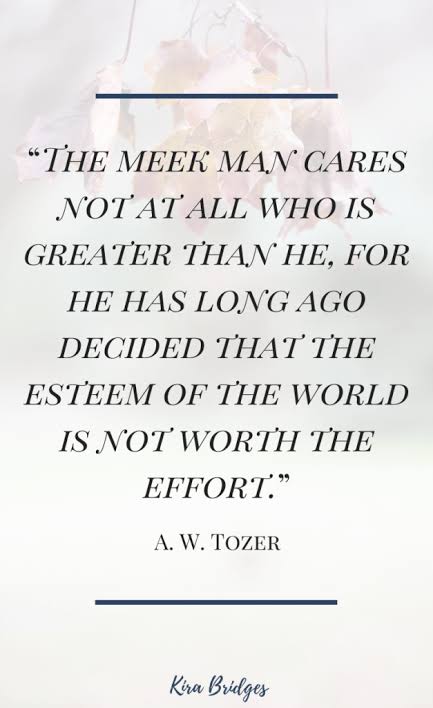
Such a burden as this is not necessary to bear. Jesus calls us to His rest, and meekness is His method. The meek man cares not at all who is greater than he, for he has long ago decided that the esteem of the world is not worth the effort.

He develops toward himself a kindly sense of humor and learns to say, “Oh, so you have been overlooked? They have placed someone else before you? They have whispered that you are pretty small stuff after all? And now you feel hurt because the world is saying about you the very things you have been saying about yourself? Only yesterday you were telling God that you were nothing, a mere worm of the dust. Where is your consistency? Come on, humble yourself, and cease to care what men think.”

The meek man is not a human mouse afflicted with a sense of his own moral life as bold inferiority.

Rather, he may be as a lion and as strong as Samson; but he has stopped being fooled about himself. He has accepted God’s estimate of his own life.

He knows he is as weak and helpless as God has declared him to be, but paradoxically, he knows at the same time that he is in the sight of God of more importance than angels. In himself, nothing; in God, everything. That is his motto.

He knows well that the world will never see him as God sees him and he has stopped caring.

He rests perfectly content to allow God to place His own values. He will be patient to wait for the day when everything will get its own price tag and real worth will come into its own.

Then the righteous shall shine forth in the Kingdom of their Father.

He is willing to wait for that day. In the meantime he will have attained a place of soul rest. As he walks on in meekness he will be happy to let God defend him. The old struggle to defend himself is over.

He has found the peace which meekness brings. Then also he will get deliverance from the burden of pretense.

Sin has played many evil tricks upon us, and one has been the infusing into us a false sense of shame. There is hardly a man or woman who dares to be just what he or she is without doctoring up the impression.

The man of culture is haunted by the fear that he will some day come upon a man more cultured than himself. The learned man fears to meet a man more learned than he.

The rich man sweats under the fear that his clothes or his car or his house will sometime be made to look cheap by comparison with those of another rich man.

These burdens are real, and little by little they kill the victims of this evil and unnatural way of life.

And the psychology created by years of this kind of thing makes true meekness seem as unreal as a dream, as aloof as a star.

To all the victims of the gnawing disease Jesus says, “Ye must become as little children.” For little children do not compare; they receive direct enjoyment from what they have without relating it to something else or someone else.

Only as they get older and sin begins to stir within their hearts do jealousy and envy appear. At that early age, the galling burden comes down upon their tender souls, and it never leaves them till Jesus sets them free.

Another source of burden is artificiality. I am sure that most people live in secret fear that some day they will be careless and by chance an enemy or friend will be allowed to peep into their poor empty souls. So they are never relaxed.

This unnatural condition is part of our sad heritage of sin, but in our day it is aggravated by our whole way of life.

Advertising is largely based upon this habit of pretense. Books are sold, clothes and cosmetics are peddled, by playing continually upon this desire to appear what we are not.

Artificiality is one curse that will drop away the moment we kneel at Jesus’ feet and surrender ourselves to His meekness.

Then, we will not care what people think of us so long as God is pleased.

Then what we are will be everything; what we appear will take its place far down the scale of interest for us.

Apart from sin, The heart of the world is breaking under this load of pride and pretense. There is no release from our burden apart from the meekness of Christ.

Good, keen reasoning may help slightly, but so strong is this vice that if we push it down one place it will come up somewhere else.

To men and women everywhere Jesus says, “Come unto me, and I will give you rest.”

The rest He offers is the rest of meekness, the blessed relief which comes when we accept ourselves for what we are and cease to pretend.

It will take some courage at first, but the needed grace will come as we learn that we are sharing this new and easy yoke with the strong Son of God Himself.

Aw Tozer: The Pursuit of God

Crucified with Christ

“I am crucified with Christ.”
Galatians 2:20


The Lord Jesus Christ acted in what he did as a great public representative person, and his dying upon the cross was the virtual dying of all his people.

Then all his saints rendered unto justice what was due, and made an expiation to divine vengeance for all their sins.

The apostle of the Gentiles delighted to think that as one of Christ’s chosen people, he died upon the cross in Christ. He did more than believe this doctrinally, he accepted it confidently, resting his hope upon it.

He believed that by virtue of Christ’s death, he had satisfied divine justice, and found reconciliation with God.

Beloved, what a blessed thing it is when the soul can, as it were, stretch itself upon the cross of Christ, and feel, “I am dead; the law has slain me, and I am therefore free from its power, because in my Surety I have borne the curse, and in the person of my Substitute the whole that the law could do, by way of condemnation, has been executed upon me, for I am crucified with Christ.”

But Paul meant even more than this. He not only believed in Christ’s death, and trusted in it, but he actually felt its power in himself in causing the crucifixion of his old corrupt nature.

When he saw the pleasures of sin, he said, “I cannot enjoy these: I am dead to them.”

Such is the experience of every true Christian. Having received Christ, he is to this world as one who is utterly dead.

Yet, while conscious of death to the world, he can, at the same time, exclaim with the apostle, “Nevertheless I live.” He is fully alive unto God. The Christian’s life is a matchless riddle.

No worldling can comprehend it; even the believer himself cannot understand it. Dead, yet alive! crucified with Christ, and yet at the same time risen with Christ in newness of life!

Union with the suffering, bleeding Saviour, and death to the world and sin, are soul-cheering things. O for more enjoyment of them!

Source: Charles Spurgeon Gems

TOZER DAILY: The Pursuit of God

To have found God and still to pursue Him is the soul’s paradox of love, scorned indeed by the too-easily-satisfied religionist, but justified in happy experience by the children of the burning heart.

St. Bernard stated this holy paradox in a musical quatrain that will be instantly understood by every worshiping soul:

We taste Thee, 0 Thou Living Bread,
“And long to feast upon Thee still: We drink of Thee, the Fountainhead And thirst our souls from Thee to fill.”


We need not fear that in seeking God only we may narrow our lives or restrict the motions of our expanding hearts. The opposite is true. We can well afford to make God our All, to concentrate, to sacrifice the many for the One.

When the Lord divided Canaan among the tribes of Israel, Levi received no share of the land. God said to him simply, “I am thy part and thine inheritance,” and by those words made him richer than all his brethren, richer than all the kings and rajas who have ever lived in the world.

And there is a spiritual principle here, a principle still valid for every priest of the Most High God.

The man who has God for his treasure has all things in One.

Many ordinary treasures may be denied him, or if he is allowed to have them, the enjoyment of them will be so tempered that they will never be necessary to his happiness.

Or if he must see them go, one after one, he will scarcely feel a sense of loss, for having the Source of all things he has in One all satisfaction, all pleasure, all delight.

IWhatever he may lose, he has actually lost nothing, for he now has it all in One, and he has it purely, legitimately and forever.

Tozer Daily: Hungering after God.

“My soul followeth hard after thee: thy right hand upholdeth me.” – Ps. 63:8


Come near to the holy men and women of the past and you will soon feel the heat of their desire after God.

They mourned for Him, they prayed and wrestled and sought for Him day and night, in season and out, and when they had found Him the finding was all the sweeter for the long seeking.

Moses used the fact that he knew God as an argument for knowing Him better. “Now, therefore, I pray thee, if I have found grace in thy sight, show me now thy way, that I may know thee, that I may find grace in thy sight”; and from there he rose to make the daring request, “I beseech thee, show me thy glory.”


God was frankly pleased by this display of ardour, and the next day called Moses into the mount, and there in solemn procession made all His glory pass before him.


David’s life was a torrent of spiritual desire, and his psalms ring with the cry of the seeker and the glad shout of the finder.

Paul confessed the mainspring of his life to be his burning desire after Christ. “That I may know Him,” was the goal of his heart, and to this he sacrificed everything.

“Yea doubtless, and I count all things but loss for the excellency of the knowledge of Christ Jesus my Lord: for whom I have suffered the loss of all things, and do count them but refuse, that I may win Christ.”


How tragic that we in this dark day have had our seeking done for us by our teachers.

Everything is made to centre upon the initial act of “accepting” Christ (a term, incidentally, which is not found in the Bible), and we are not expected thereafter to crave any further revelation of God to our souls.


We have been snared in the coils of a spurious logic which insists that if we have found Him we need no more seek Him.

Thus the whole testimony of the worshiping, seeking, singing Church on that subject is crisply set aside.


In the midst of this great chill, there are some I rejoice to acknowledge, who will not be content with shallow logic. They will admit the force of the argument, and then turn away with tears to hunt some lonely place and pray, “O God, show me thy glory.”

They want to taste, to touch with their hearts, to see with their inner eyes the wonder that is God.


I want deliberately to encourage this mighty longing after God. The lack of it has brought us to our present low estate.

The stiff and wooden quality about our religious lives is a result of our lack of holy desire. Complacency is a deadly foe of all spiritual growth.

Acute desire must be present or there will be no manifestation of Christ to His people. He waits to be wanted.


Every age has its own characteristics. Right now we are in an age of religious complexity.

The simplicity which is in Christ is rarely found among us. In its stead are programs, methods, organizations and a world of nervous activities which occupy time and attention but can never satisfy the longing of the heart.

The shallowness of our inner experience, the hollowness of our worship, and that servile imitation of the world which marks our promotional methods all testify that we, in this day, know God only imperfectly, and the peace of God scarcely at all.

If we would find God amid all the religious externals we must first determine to find Him, and then proceed in the way of simplicity.

Now, as always, God reveals Himself to “babes” and hides Himself in thick darkness from the wise and the prudent.

We must simplify our approach to Him. We must strip down to essentials (and they will be found to be blessedly few). We must put away all effort to impress, and come with the guileless candor of childhood.

If we do this, without doubt God will quickly respond.

AW TOZER

Earthly Palliatives and our Eternal Reward

During the Covid outbreak, some part of Nigeria was declared to be on lockdown. Businesses were locked up. Movements were restricted. Churches were closed. Everyone was ordered to stay closed.

During the lockdown, in order to support the citizens and keep them strong, the government began to send food items to these starving homes.

The food items were known as Palliatives. They weren’t much, but they were enough to sustain the families until the pandemic was over in Nigeria.

These Palliatives were simply basic requirements for survival during the pandemic.

In 1 Peter 2:11, we are called strangers and pilgrims in this world. We belong to a better world. We are citizens of heaven, even while we journey here on Earth.

We are here to serve God, fulfill His Counsel for mankind, and draw more people to Him.

Nevertheless, God has not and will never leave us stranded. Even though we are pilgrims on a journey to eternity, we are not left to fend for ourselves here.

2 Peter 1:3: “According as his divine power hath given unto us all things that pertain unto life and godliness, through the knowledge of him that hath called us to glory and virtue”

As you serve God here on Earth, He’ll definitely provide financial breakthroughs for you, but you mustn’t be complacent when they start coming.

You must realize that these things are like Palliatives. They’re temporal and not lasting. They are only meant to keep our body strong as we do God’s work here on Earth.

The cars aren’t the rewards for serving God, neither are the houses or abundance of currency. These things might be given unto you in large measure. But in some cases, God chooses to give them in measures likened to the droplets of the drizzling rain.

Hence, the Saint must decide that whether he amasses great wealth here on Earth, or earns only little for sustenance of himself and his family, his eyes will remain fixed on the Eternal reward.

The Palliatives here are only temporal. They are corruptible and perishing. A brand new car bought today would cause a lot of celebration and Thanksgiving. It will be valued and treasured like gold.

But there is no doubt, that within five years from now, that car will lose its value. It will begin to rust, having sufferered severely from the potholes in the roads, the collusion with other cars and dealings from the mechanic.

The same can be said for every material gift.

Woe unto the one who serves God for material gain. You will be the most miserable of all saints.

Work for that reward which is eternal. Labor for the kingdom as much as you can, that on the last day, you shall receive a crown of glory decorated with several glittering stars.

1 Timothy 6:17: ‘Charge them that are rich in this world, that they be not highminded, nor trust in uncertain riches, but in the living God….’

Let not the rich trust in their riches. But let the rich and the poor trust in God.

Let them serve with all diligence. Whether you are in the choir, or in the Evangelism unit, or in the pastoral department, or in a secular engagement, labor for the kingdom.

Use every opportunity you have to work for the kingdom. Because God takes record of every single thing you do for Him. For every sweat that trickles down your face, for every tear you shed, every cent you spend, every sound you make, every loss you incur, for the promotion of God’s kingdom, there is a huge reward for it.

Set your eyes upon it. The day of the Lord is coming. The day when He will reward all of us justly.

Will your labor be worth rewarding?


The Gate and The Way; An Exposition on Matthew 7:14

It is written in the scriptures that: strait is the gate, and narrow is the way, which leadeth unto life, and few there be that find it (Matt 7:14)

There is therefore a GATE, and a WAY.

A gate is a crisis point, requiring one to pass through. You are either on this side of the gate, or the other side.

Passing through a gate is not a gradual process, it occurs at once. A way on the other hand, is traversed gradually.

Walking on a way does not occur at once. Rather, we make progress over time. We have gate experiences and way experiences. And both are essentially distinct, though connected.

From the scripture above- the gate comes first, then the way. There is that hymn (To God be the glory) that says Jesus yielded His life an atonement for sin and opened the life-gate THAT ALL MAY GO IN.

That’s the truth.

When people ‘give their lives to Christ’ over and over again thinking they did not do it well the previous time, or because the meeting is intense, or because of the things they have done since the last time they received Christ.

When we rededicate our lives to God several times, and confess sins and ask for forgiveness regularly, especially before bed- jolted and even scared by messages of the appearing or coming of Christ and messages of hell.

When we feel guilt about past sins and even go ahead to say things like ‘we are all sinners, except for the blood of Jesus.’ When we are always stumbling over the same sins and repenting of them….

We are trying to walk upon the way without acknowledging that there is a gate to pass through.

It will never work.

We need to know what happened to us at the gate. Without the gate, we will struggle to make heaven- an impossibility in itself.

Until we see the gate, progress upon the way will be impossible, and we will keep going back to start point- repenting again, starting again, instead of moving on to perfection.

There is nothing as frustrating as trying to enter into a room you are already in.

THEREFORE, there is a GATE


At the gate is Christ, at the gate is the Cross, at the gate the Lamb was slain, and our sins forgiven, and guilt rolled away.

At the gate Christ met us- He loved us, He took us unto Himself. He died for us and rose again. When He died, we died with Him, and when He rose, were raised together.

If anyman is in Christ therefore- He is a new creature. The gate is not about what we have done or what we should do, but about what God has done in Christ. Changes here are instantaneous.

God has done everything in Christ, and then put us in Him. The moment we believe it, we receive it, and we become it- not in a hidden way, but manifestly.

It is credited to our account as righteousness.

Therefore at the gate we are free, at the gate there is therefore now no condemnation. At the gate old things are passed away. At the gate all things are become new, at the gate we have passed from death to life. At the gate we are a new creation, at the gate we have been healed by His stripes. At the gate, we are seated with Christ in heavenly places.

It does not occur gradually- but if anyman is in Christ, He is- not that he will be, but he is.

Not that old things are passing away, but they have. Not that all things are becoming new- but they have.

That is the strait gate.

LIKEWISE, THERE IS ……A WAY.

Sometimes we focus on the gate, and forget the way.

Sometimes we don’t know the difference between where we are seated, where we are walking, and where we are standing.

We forget that while we are seated with Christ in heavenly places, we are pressing towards the mark for the prize of the upward call of God in Him.

We forget that we are seated with Christ in heaven, walking in Him on earth, and standing with Him against hell.

And that while our seating position is fixed on high, it does not change the fact that progress has to be made here in this realm.

We claim everything has been already done and there is nothing left for us to do.

But faith is both he who comes to God and he who diligently seeks Him.

A W Tozer says to have found God and to pursue him is the sweet paradox of Christianity.

Those who pass through the gate must be prepared to walk the way.

At the gate God found us, on the way we find Him.

At the gate- God loved us, on the way we love Him.

At the gate- we are planted in Christ, on the way Christ is expressed through us.

At the gate victory is delivered, but on the way battles will be fought.

At the gate inheritance has been entrusted, but on the way the heirs will be tested.

At the gate- we are forgiven, on the way- we must forgive others.

At the gate- we are perfected, on the way- we learn perfection.

At the gate- we are born again, on the way- we live again.

At the gate- we are justified, on the way-we are sanctified

At the gate- we repent as sinners, on the way- we repent out of righteousness.

At the gate, faith is received…on the way we add to our faith.

At the gate- the Cross carried us once…On the way we carry our cross daily.

At the gate- the old man is crucified with Christ; on the way we mortify its members which are on the earth

At the gate- Christ died for us; on the way, we live for Him

At the gate- Christ becomes the Author of our faith, and on the way- He is the Finisher

At the gate- we become children of light, on the way, we walk in the light.

At the gate is the new birth, on the way is the new life (the new and living way)

At the gate- we become sons by birth, on the way- we become sons by (training, which is by) adoption

At the gate- we receive eternal life as a seed (the seed of God); on the way, we develop eternal life as a fruit

At the gate- we receive (as some like to say) God’s DNA, or genotype; but on the way, we develop God’s phenotype

At the gate- we are made partakers of the divine nature; on the way, we are made partakers of His holiness

That is the narrow way.

And at a time when some of us have indeed constituted ourselves super-teachers, we need someone to again teach us the elementary principles of Christ and have become dull of hearing and for all our verbosity, are unskillfull in the word of righteousness and unable to discern good from evil.

For he that does not make progress, being waylaid by the inertia, it seems these days, of false doctrine; is shortsighted, and cannot see afar of; and has forgotten that he was cleansed from his past sins as well as other ‘gate experiences’ though he makes a great noise about them.

Let as many therefore who claim to have entered in at the gate know that the one proof thereof, and the only,

Is to walk the way.

Cheers.

Ebele UzoPeters

Faith over Feelings

Even though God can be touched by your feelings, and even though He became flesh to bear your sorrows, and even though He is the Comforter, remember that He is not an emotional God.

God is spirit, not soul. Faith is spiritual. Emotions are not spiritual. They are soulish. God is a faith God. He is a God of Love. There is spiritual love and humanistic love. They are not the same thing.

Human love is very nice. Human love is superficial.
Human love can change to hate in a second.

God’s love is kind. God’s love has a red fount, in the blood of Christ Jesus. God’s love is transforming.

Always learn to separate your emotions from your faith. Don’t be stoic. Have feelings. Pour them out before God; but remember that they are your feelings.

God can touch your feelings and know them; but if you want to touch His feelings and know them, have Faith. Only faith. Just faith.

When a baby is crying and the mother comes to carry it, it stops. Why?

Is it because the tears have run dry? No. The baby has some faith in its mother.

If you needed one million naira today, and the richest man in the world met you and asked you what you wanted, will you keep crying?

No. Why? You have some faith in his ability.

1 Samuel 30:4
Then David and the people that were with him lifted up their voice and wept, until they had no more power to weep.

1 Samuel 30:6
And David was greatly distressed; for the people spake of stoning him, because the soul of all the people was grieved, every man for his sons and for his daughters: BUT DAVID ENCOURAGED HIMSELF IN THE LORD his God.

1 Samuel 30:8
AND DAVID ENQUIRED AT THE LORD, saying, Shall I pursue after this troop? shall I overtake them? And he answered him, Pursue: for thou shalt surely overtake them, and without fail recover all.

.

John 11:35
Jesus wept.

John 11:38
Jesus therefore again groaning in himself cometh to the grave. It was a cave, and a stone lay upon it.

John 11:41
Then they took away the stone from the place where the dead was laid. AND JESUS LIFTED UP HIS EYES, AND SAID, FATHER, I thank thee that thou hast heard me.

.

When you have finished weeping.

Do likewise.

Jesus is alive, and He is Lord.

———————–

2 Prime Elements of Christian Culture that you must know!

  Culture is the way of life of a group of people. It includes their values, their mode of dressing, their language, customs and traditions. In some villages, here in Africa, there are certain days in which neither marriages nor burials are head.

It is their custom there, and though a pagan belief, they stick by it, and they punish those who break it. That is how strong the idol worshippers adhere to their culture. The strength of every village lies not in the god they serve, but in the culture they inculcate in the villagers present there.

The same way the idol worshippers have their culture, is the same way this world at large has its culture.

THE WORLD HAS A CULTURE


Have you ever observed that the moment one announces publicly that one is a homosexual; one receives praises and applause from different ‘Human Rights’ organizations.

But when one publicly speaks against homosexuality, one is criticized and labelled as a, ‘Religious Extremist’. It is their culture! The culture of the world celebrates sodomy. They celebrate ladies wearing clothes that reveal sensitive parts of their body. Fornication and abortion fall under the culture of the world. The culture of this world includes everything that contradicts God’s principles and laws.

Divorce, Pornography. These are all permissible under the culture of the world.

Living in this world even as a believer, one can be tempted to yield to the culture of the world, just to belong and avoid being persecuted.

But in Romans 12, Paul speaks vehemently against it.

Romans 12:2: “Do not conform any longer to the pattern of this world…..”

THE KINGDOM OF GOD ALSO HAS A CULTURE!

Ephesians 5:8: For you were once darkness, but now you are light in the Lord. Live as children of light” (NIV)

There is a way we live as the light of the world. When we got born again, even though our spirits were recreated, our mind and our behaviours remained the same. But God expects that as we grow in our faith, we begin to remove these negative thinking and behavioural patterns and develop in us, the pattern of living for Christians.

This Kingdom Culture is what has made many great in this kingdom. It is what has made many believers survive the hardest of opposition and live an ever victorious life.

1. THE CULTURE OF ENQUIRY

2 Samuel 2:1

In the course of time, David enquired of the Lord. “Shall I go up to one of the towns of Judah?” he asked. The Lord said, “Go up.” David asked, “Where shall I go?” “To Hebron,” the Lord answered. (NIV)

Proverbs 3:6: “in all your ways acknowledge him, and he will make your paths straight.” (NIV)

True saints are never presumptuous about what to do. They always enquire from God before making choices.

Believers who are confused and lacking direction are believers who have not developed the culture of always enquiring from God.

Most of the divorces that happened in Christian marriages happened because of the inability to enquire from the Lord before stepping into that marriage.

God wants us to acknowledge Him, not just in our businesses, or in our education, but in all our ways.

Have you sought for the Lord’s permission to do business with that partner?

Have you sought for the Lord’s permission to take your kids to that school?

When we teach on these things, we are tagged as extremists. But extremism is actually when you live your life and you make your choices without bothering about what God has to say about it.

Take a look at this:

Proverbs 3:6: “Listen for GOD’s voice in everything you do, everywhere you go…” (MSG)

You don’t need to hear the ‘loud’ voice of God before knowing that God has spoken.

God speaks in different ways.

He can implant a strong, compelling resistance deep within you.

He can give a sense of optimism and tranquillity to your spirit.

He can speak through your pastor.

He speaks in many ways. We do not hear because we are not concerned with what He has to say.

Develop the habit of always asking God,

‘What should I do’

‘Is this right’ ‘Is she the right one’. ‘Should I go ahead and do this’. It will save you from a lot of trouble.

2. THE CULTURE OF SENSITIVITY

Source: Paul Sohn

Luke 5:22: “But when Jesus perceived their thoughts…. (KJV)

Luke 20:23

But he perceived their craftiness, and said unto them, Why tempt ye me? (KJV)


Jesus was the most controversial public figures in His humanity on Earth.

He was hated and despised by the cunning Jewish Rabbis. As result of their hatred, they made several attempts to get him entangled in serious problems, by asking him tricky questions.

Just like Jesus, Christians are hated around the world, by the world. In places like China and North-Eastern Nigeria, Christians are being murdered in large numbers.

The world hates Christians, and they always look for ways to get them in problems. Hence, you cannot afford to live in this world as a genuine, devout Christian and not be sensitive.

Spiritual sensitivity doesn’t mean a believer should live in suspicion, reclusiveness and timidity. It simply means we must be proactive and discerning in our daily works.

Spiritual sensitivity is a culture, and a skill that the believer must master. There are times I interact with very jovial people, yet, because I have a trained spirit, I can see beyond their jovial outlook, to behold the depressed and destabilized person they are within. This helps me a lot in liberating people from depression.


Training your spiritual sensitivity is quite simple.

i. Pray regularly. Prayer keeps us in spirit-mode. This helps us capture spiritual signals and signs that God sends into our spirit to keep us safe and prosperous.

ii. Observe fasts at intervals: The absence of our fasting causes our spirits to get rusted; and it reduces the ability of our spirit to get necessary information quickly.

iii. Do not be in a hurry! Always stop to ponder and meditate before doing things. Be ever cautious of what the Holy Spirit is saying within you.


These two principles outlined above, are quite necessary for you to imbibe.

If you do not imbibe the culture of God’s kingdom, you will be like an old wine skin carrying a new wine.

It will make you a misfit both to the Kingdom of God and to the world. Develop the habit of always enquiring from God. Develop the habit of being sensitive to His voice within you.


Pray this prayer:

“Dear Father, I thank you for giving me access to your counsel and wisdom. Having gotten knowledge of the utmost priority of seeking your counsel in my daily endeavours, I decide that from today, I shall continually enquire from you. I shall seek your approval or disapproval in whatever I am going to do. I shall listen for your voice in whatever way it comes. Thank you, Father. In Jesus’ name I pray, Amen”.

Now, go ahead and put what you learnt tonight into practice.


We would love to hear from you. Koinonia Art is all about Christian-Christian interaction. Drop a comment, a question, appreciation, testimony etc. and we will reply right away.

Shalom!

Sunday Ministers’ Special: Experience God like Spurgeon

Charles Spurgeon was a unique combination of personality and prayer. His multifaceted ministry life fell into orbit around his devotional life.

But how did Spurgeon remain devoted to God in the midst of all the distractions that constantly pulled at his attention?

How did Spurgeon keep his focus on Jesus Christ admist the crashing waves of life?

Here are several lessons from Spurgeon about maintaining intimacy with God in the busyiness and routine of everyday life.

1. Experience intimacy with God through the personality He has given you.


Spurgeon had a marvelous and magnetic personality. He was winsome, profound, easy to speak with, and he never forgot a face.

He once told his students, “I once counted eight sets of thoughts which were going on in my brain simultaneously, or at least within the space of the same second.”

No doubt, his memory assisted his pastorate that contained nearly 6,000 members. It was, indeed, a “megachurch” long before that word ever came into the vernacular.

Spurgeon provided oversight to sixty-six organizations, preached multiple times each week, and was a voracious reader. How, then, did he carve out time for prayer and personal devotion?

“I quarry out the truth when I read, but I smelt the ore and get the pure gold out of it when I meditate!”

Spurgeon was once told that a man spent three hours on his knees in prayer.

Spurgeon reponded, “I could not do it if my eternity depended on it!” Then his friend, William, recalled Spurgeon saying,

“I go to God with a promise, which is in reality a cheque issued by God Himself on the bank of heaven. He cashes it for me, and then I go and use what He has given me, to His glory. . . I think I can say that seldom many minutes elapse without my heart speaking to God in either prayer or praise.”

The key to Spurgeon’s prayer life was saturation. By living in a constant atmosphere of prayer and devotion, Spurgeon permeated his life with prayer and that shaped his personality.

2. Allow God to Speak


Another unique aspect of Spurgeon’s walk with God is found in his daily entry into His presence.

He said, “Be much with God in holy dialogue, letting Him speak to you by His Word while you speak back to Him by your prayers and praises.” He understood that “thought is the backbone of study.”

By allowing God to guide our thoughts, Spurgeon focused on responding to God leading. He explained:

“I have spread the Bible on my chair, kneeled down, put my finger upon the passage, and sought of God instruction. I have thought that when I have risen from my knees I understood it far better than before.”

Spurgeon liked to linger on a particular Scripture passage while prayerfully listening as the Holy Spirit illuminated its message.

Of course, there is a always a tendency for us to rush into God’s presence with personal agendas and self-centered to-do lists.

But, when God initiates his conversation with us through Scripture, prayer become God-centered and kingdom-focused.

3. Build an Entry Ramp and Drop an Anchor

Spurgeon not only spoke of meditating upon the Word of God, but he also spoke of meditating on the God of the Word.

When we enter into a conversation with our bosses and superiors, it’s always wise to listen more than we speak.

Likewise, when we approach the throne of God in prayer, we must prioritize the contemplation of the One with whom we encounter.

Spurgeon told his congregation:

“O that you were busy after the true riches, and could step aside awhile to enrich yourselves in solitude, and make your hearts vigorous by feeding upon the person and work of your ever blessed Lord! You miss a heaven below by a too eager pursuit of earth. You cannot know these joyful raptures if meditation be pushed into a corner.”

“You cannot measure a fire by the bushel, nor prayers by their length.”

When we feed upon the person and presence of Jesus Christ, we become satisfied, nourished, and empowered.

Thus, the entry ramp into Scripture intake, prayer, and meditation is not one of religious obligations but intimacy.

Prayerful meditation throughout the day anchors our lives, helps us discover our center, which is Jesus Christ, and launches us into a living relationship with the ultimate Superior.

4. Stay logged in


We often encounter the website message: “Do you want to stay logged in?” In that moment, we have the option of remaining connected or logging out.

Prayer works like that, too. Throughout the day, we can unconsciously log out of prayer with a flippant “amen” and continue on with our busy lives.

However, Spurgeon would challenge us, as Scripture does, to stay logged in.

To stay attentive to God’s voice no matter where our day will lead us. Look at how Spurgeon maintained an open-ended conversation with God.

Peter Morden explains:

“His basic pattern was to pray morning and evening. . . Sometimes he would pray with his family . . . sometimes he would be alone. But his prayer life certainly did not stop there;

Spurgeon wanted to maintain continued communion with God throughout the day.

One of the ways he sought to do this was by praying short, one-sentence prayers as he went about his daily work. . . These short, pithy prayers are what have been called ‘arrow prayers’, prayers addressed to God in the midst of a day full of all sorts of different tasks.”

Fostering communion with God allowed Spurgeon to inject into each of his tasks, decisions, and relationships the guidance, discernment, and blessing that comes directly from Christ.

With Spurgeon, may each of us use our God-given personality to carve out time over the course of our routine to focus on encountering Christ through Scripture intake, prayer, and meditation.

Source: Spurgeon.com